.svg)


Electric Bike Laws in Pennsylvania, Ohio, West Virginia, Maryland, and New Jersey
Last Reviewed: 9/18/2026
If you were hurt in an e-bike or e-scooter crash, or if you were hit by someone riding one, whether you have a case can come down to a set of rules that are different in every state and that changed in three of them this year.
It is easy to assume an e-bike is just a bicycle, or that an electric scooter is street legal because you bought it at a store down the road. Then the insurance company tells you your device didn’t meet the legal definition, or that no policy covers what happened to you.
We’re licensed in Pennsylvania, West Virginia, Ohio, Maryland, and New Jersey, and the rules are not the same in any two of them. Below is what each state actually requires, and what those rules mean when someone gets hurt.
Call for a free case review. There is never a fee unless we get money for you.
Do I have a case?
There are two very different situations here, and they run on different rules.
You were riding. You were on an e-bike or e-scooter and a driver hit you, the same way a driver might cause a bicycle accident. The main questions are whether your device met your state’s legal definition, what coverage is available to you, and whether the driver’s insurance company is going to try to blame you.
You were hurt by someone else riding. You were walking, cycling, driving, or riding on the back of an e-bike when a rider caused your injury. Here the hard question is which policy pays, because e-bike riders in most of these states are not required to carry any insurance at all.
Both are situations our attorneys can review. If you’re not sure which one describes your situation, call us and we’ll sort it out.
Pennsylvania
E-Bike Laws in Pennsylvania
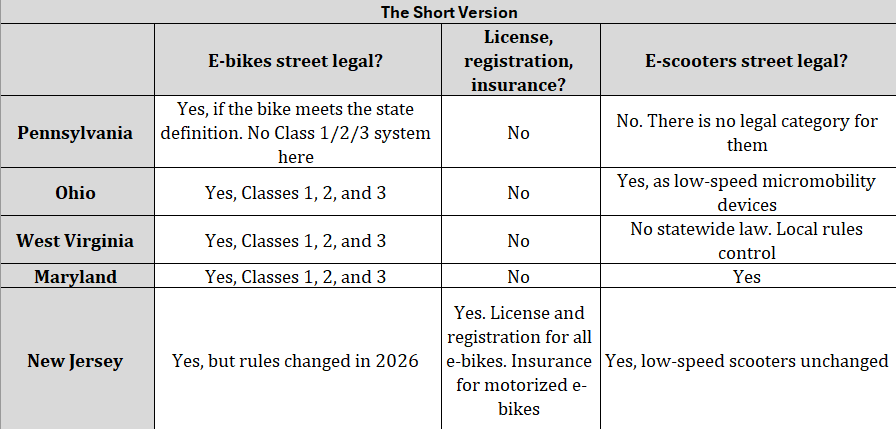
Pennsylvania does not use the Class 1, Class 2, Class 3 system you will see almost everywhere else. There is one category here, and the law calls it a pedalcycle with electric assist.
To qualify, a bike has to check every one of these boxes:
- Motor no stronger than 750 watts
- Weighs no more than 100 pounds
- Two or three wheels, each more than 11 inches in diameter
- Working pedals
- Cannot go faster than 20 mph on a level road using the motor alone
That last one catches people. The limit is about what the motor can do by itself, not how fast you can get the bike going when you pedal.
If a bike checks all those boxes, Pennsylvania treats it as a bicycle, not a motor vehicle. Here is what that means for riders:
- No license, registration, title, or insurance. [1]
- You have to be at least 16 to ride one.
- Parents can be on the hook. A parent or guardian is not allowed to let a child ride in a way that breaks these rules.
- Helmets are required only under age 12. Since you have to be 16 to ride an e-bike at all, there is effectively no helmet requirement for legal riders here. That does not make riding without one a good idea.
- Lights and reflectors are required from sunset to sunrise.
- Sidewalks are generally allowed, except in business districts and where there is a usable bike lane right alongside. Riders on sidewalks have to yield to pedestrians and give an audible signal before passing.
- Freeways are generally prohibited, with very few exceptions. It is best to avoid riding an e-bike on a freeway altogether.
If a bike does not check all the boxes, it is not an e-bike under Pennsylvania law. A bike sold as “Class 3,” which assists up to 28 mph, does not qualify. Neither does anything over 750 watts. Those land in the motor-driven cycle or motorized pedalcycle categories, which require registration, a license, and insurance, and most of them cannot meet the equipment standards to get registered in the first place. That matters for more than tickets: neither motor-driven cycles nor motorized pedalcycles are eligible for first-party benefits under Pennsylvania law. Knowing which category your bike falls into tells you which laws apply to you, and it can decide who pays your medical bills. If you were hurt on one, the situation is closer to a motorcycle accident than a bicycle crash.
E-Scooter Laws in Pennsylvania
Stand-up electric scooters are a harder problem here. Pennsylvania’s Vehicle Code has no category for them at all, so they can’t legally operate on public roads because they lack the registration and insurance a motor vehicle requires. Sidewalks are out too. Pennsylvania prohibits anything other than human-powered vehicles on sidewalks, and a scooter runs on a motor.
Pittsburgh ran a legal shared scooter program through Move PGH from 2021 until the state authorization expired in 2023. [2] There is no active program now.
What Is Changing in Pennsylvania
Several bills are moving in Harrisburg. One would legalize e-scooters and set rules of the road for them. Another, sponsored by Rep. Jill Cooper of Westmoreland County, would adopt the three-class system and let municipalities write their own e-bike ordinances. [3] [4] None have passed yet.
Local rules are moving faster than state law. At least seven municipalities around Pittsburgh have passed or are weighing ordinances restricting e-bike use on municipal property, including parks and trails. [5] If you were hurt in one of those communities, the local ordinance may matter as much as the state statute, and it’s worth talking to Pittsburgh bicycle accident attorneys who follow them.
Pennsylvania law behind this section: 75 Pa.C.S. § 102 (definition), § 1714 (ineligible claimants), § 3503 (parent responsibility), § 3507 (lights), § 3508 (sidewalks and pedalcycle paths), § 3510 (helmets), § 3511 (freeways), § 3514 (e-bike operation), § 3703 (sidewalk prohibition).
Ohio
E-Bike Laws in Ohio
Ohio uses the three-class system. If a bike has working pedals and an electric motor under 750 watts, it fits one of three classes:
- Class 1: pedal assist only, motor stops helping at 20 mph
- Class 2: throttle allowed, motor stops helping at 20 mph
- Class 3: pedal assist only, motor stops helping at 28 mph, and it needs a speedometer
The rest of the rules:
- No license, registration, or insurance for a bike that fits one of the three classes
- Class 3 riders must be at least 16, and helmets are required on Class 3. Riders under 16 may ride as passengers on e-bikes built to carry them. Ohio law is silent on a minimum age for Class 1 and Class 2
- E-bikes sold in Ohio must carry a permanent label showing the class, top assisted speed, and wattage. If the bike is modified, the label has to be updated to reflect the changes
- Ohio changed its state park rules on May 21, 2026. Class 1 and Class 2 are allowed on paved and shared-use paths where bicycles are allowed, unless a sign says otherwise. Natural-surface mountain bike trails are Class 1 only [6] [7]
E-Scooter Laws in Ohio
Scooters are legal in Ohio, where the law calls them low-speed micromobility devices. The device has to weigh under 100 pounds, have handlebars, and top out at 20 mph. Riders must be 16 to use the road, and riders under 16 must be supervised by an adult. Helmets are required under 18. No license, registration, or insurance.
Sidewalk riding is allowed under state law by default, but Columbus, Cleveland, and Cincinnati have all passed their own restrictions.
Ohio law behind this section: Ohio Rev. Code § 4509.01 (definitions), § 4511.01 (definitions), § 4511.522 (e-bike operation), § 4511.514 (scooters).
West Virginia
E-Bike Laws in West Virginia
West Virginia uses the same three-class system as Ohio and Maryland. Working pedals and a motor under 750 watts, and the bike is treated like a bicycle.
- No license, registration, title, or insurance
- Helmets are required for riders and passengers under 15. That is a year younger than most states, so it is easy to get wrong
- Class 3 bikes need a speedometer
- Class 1 and Class 2 can go where regular bicycles go. Class 3 access to bike paths is restricted
- Modifying a bike to push it past its class limits is not allowed
E-Scooter Laws in West Virginia
There is currently no statewide scooter law in West Virginia. The rules are set city-by-city and they genuinely differ. Charleston allows scooters to operate under bicycle traffic laws with lights at night. Wheeling has more detailed regulations. Some towns have not addressed scooters at all.
If you were hurt on a scooter in West Virginia, the local ordinance is the first thing that needs checking.
West Virginia law behind this section: W. Va. Code § 17C-1-70 (definitions), § 17C-11-8 (operation; subsection (i)(2) sets the under-15 helmet rule), § 17C-11A-4 (Child Bicycle Safety Act).
Maryland
E-Bike Laws in Maryland
Maryland uses the three-class system as well, and classifies e-bikes as bicycles rather than motor vehicles or motorcycles. Motor capped at 750 watts, working pedals, and a permanent label on the frame showing the class.
- No license, registration, or insurance
- Class 3 needs a speedometer, riders have to be 16 or older, and Class 3 is generally kept off bicycle paths
- Helmets are required on public property for riders and passengers under 16
- Modifying a bike means the class label has to be updated
- Sidewalk and trail access is set locally. Baltimore City bans bicycles on sidewalks [8]
- On the C&O Canal towpath, the National Park Service allows e-bikes but not using the motor to move without pedaling, with a 15 mph limit on designated routes [9]
E-Scooter Laws in Maryland
Scooters are legal in Maryland. The law calls them electric low speed scooters: two wheels, capped at 20 mph on flat ground, and designed to carry only the operator. No registration, title, or license required. Helmets under 16. [10]
One Maryland Rule That Can Decide Your Whole Case
Maryland still follows contributory negligence. If you are found even one percent at fault for what happened, you can be barred from recovering anything at all. [18]
That applies to every injury case in Maryland, not just e-bike and scooter crashes, and it is the biggest thing working against an injured rider in this state. There is one narrow exception. More on how that works in the section on what these laws mean for your claim.
Maryland law behind this section: Md. Code, Transp. § 11-104 (bicycle definition), § 11-117.1 (electric bicycle classes), § 11-117.2 (electric low speed scooters), § 11-135 (motor vehicle), § 21-1205.2 (operation and path access), § 21-1207.1 (helmets).
New Jersey
New Jersey rewrote its e-bike law in 2026. If you are reading anything published before this year, it is out of date.
E-Bike Laws in New Jersey
The governor signed the new law on January 19, 2026, and enforcement started July 19 after a six-month grace period. [11] It replaced the old three-class system with three new categories:
- Motorized Bicycle. Covers bikes with a helper motor up to 1.5 brake horsepower, throttle-only bikes up to 15 mph, pedal-assist bikes between 21 and 28 mph, and throttle bikes over 15 mph up to 28 mph
- Low Speed Electric Bicycle. Pedal assist only, up to 20 mph
- Electric Motorized Bicycle. Two wheels, working pedals, 750 watts maximum, 28 mph maximum
Here is what is required now: [12]
- A license. The minimum age to operate is 15, and New Jersey requires riders to pass an exam covering how the bike works and the rules of the road, similar to a driver’s test
- Registration with the Motor Vehicle Commission for every e-bike. Low Speed Electric Bicycles have to be registered but do not need insurance
- Liability insurance for motorized bicycles
- Helmets. A DOT-approved helmet is required at all times for anyone operating a motorized bicycle. For low-speed e-bikes, the bicycle rule applies, so helmets are required under age 17 and local rules may add more
- People who already owned e-bikes were not grandfathered in
- The law also paused online e-bike sales in New Jersey until January 19, 2027, and banned modification kits that turn low-speed bikes into faster ones
New Jersey is the only one of these five states that requires a license and registration to ride an e-bike.
E-Scooter Laws in New Jersey
Scooters did not change. Low-speed electric scooters still run under the 2019 law. They are allowed on streets, roadways, and bicycle paths, and can be parked on sidewalks as long as they are not blocking anyone. No registration, insurance, or driver’s license. Helmets under 17.
New Jersey Treats Low-Speed Riders as Pedestrians
This one is worth knowing if you were hurt. New Jersey’s definition of “pedestrian” now includes anyone operating a bicycle, a low-speed electric bicycle, or a low-speed electric scooter. If a pedestrian is hurt or killed in an accident, that injury is covered by the pedestrian’s own personal injury protection coverage.
In plain terms, if you were on a low-speed e-bike or scooter in New Jersey and someone hit you, your own auto policy’s medical benefits may be the first place to look.
Local Bans Are Spreading in New Jersey
Union County issued an executive order banning e-bikes and e-scooters from all county park property, including footbridges, bike paths, lawns, and playgrounds. Florham Park passed an ordinance that can hold parents responsible for violations by teenage riders. [13]
New Jersey law behind this section: P.L.2025, c.285 (2026 e-bike law), N.J.S.A. 39:4-10.1 (bicycle helmets), 39:4-14.3e (compulsory liability insurance for motorized bicycles), 39:4-14.3f (accidents involving e-bikes), 39:4-14.3i.1 (e-bike registration), 39:4-14.3q (motorized bicycle helmets), 39:4-14.16 (low-speed electric bicycles and scooters).
What these laws mean if you were hurt
This is where it gets practical.
If you were riding and a driver hit you
The first fight is usually over what you were riding. Insurance companies look hard at whether the device met the statutory definition. They will argue the motor was over 750 watts, that it could exceed 20 mph on motor power alone, or that throttle use put it in a different category. That argument is not just about traffic tickets. It affects what coverage applies to you, the same way it would in any car accident claim.
What helps: the manufacturer’s specifications, the permanent class label if your state requires one, receipts for any components, app or trip data from the bike, and in a contested case an inspection by someone who can testify about it.
Pennsylvania: your own auto policy may matter more than you think.
Because a qualifying e-bike is a pedalcycle and not a motor vehicle in Pennsylvania, an e-bike rider struck by a car is generally in the same position as a bicyclist or a pedestrian. Limited tort applies to people occupying private passenger motor vehicles, and a bicyclist or pedestrian struck by a car is generally not bound by the limited tort election on their own auto policy. That means pain and suffering damages may still be available even if you chose limited tort. Uninsured and underinsured motorist coverage on your own policy may also apply if the driver who hit you had no insurance or not enough. All of this depends on the language of your own insurance policy.
E-bikes are new enough that Pennsylvania courts have not ruled on this directly. The conclusion rests on e-bikes being classified as bicycles, which is why the classification question above matters so much. The best step after being struck by a vehicle while riding your e-bike is to contact an attorney to see what your options are.
Pennsylvania law behind the auto policy section: 75 Pa.C.S. § 1705 (limited tort), § 1713 (first-party benefits), § 1714 (ineligible claimants), § 1731(d)(2) (uninsured and underinsured motorist coverage). See also L.S. ex rel. A.S. v. Eschbach, 874 A.2d 1150 (Pa. 2005).
If you were riding something that wasn’t street legal.
Riding a device that doesn’t meet your state’s definition doesn’t automatically end your claim. A driver who runs a red light is still responsible for running a red light. It does change how the case gets handled, and in a state like Maryland it can raise questions about your own share of the fault. The best step in that situation is to talk to an attorney and find out what your options actually are.
If you were hurt by someone riding an e-bike
This is the harder coverage problem. Pedestrians, cyclists, and passengers riding on the back of an e-bike all end up here.
The problem: in Pennsylvania and in most of these states, e-bike riders are not required to carry any liability insurance. Pennsylvania requires financial responsibility for motor vehicles that must be registered, and a qualifying e-bike is a pedalcycle, so it falls outside that requirement. That means there may not be an auto liability policy sitting there waiting to pay the claim.
Where coverage may come from instead:
Homeowners or renters insurance. This is often the best available option, and whether it works depends entirely on the language of that specific policy. Many homeowners policies exclude personal liability for injuries arising out of the ownership, maintenance, or use of a motor vehicle. If the policy treats an e-bike as a motor vehicle, that exclusion can wipe out coverage. If the policy is ambiguous about it, Pennsylvania courts construe ambiguous policy language in favor of the policyholder and against the insurance company that wrote it. [14]
Pennsylvania appellate courts have gone both ways on similar vehicles. In two cases involving dirt bikes, courts found the policy language clear and applied the exclusion, leaving no coverage. [15] [16] In a case involving an ATV, the court found the plain language of the policy did provide coverage. [17] There is no Pennsylvania decision on e-bikes specifically yet.
E-bike specific insurance. Some riders carry it. There are companies that write e-bike policies specifically, and several large carriers have started offering e-bike coverage as part of their plans. It is not required by Pennsylvania law, so most riders do not have it, but it is worth finding out whether the person who hit you did.
Maryland is different, and it matters
Maryland follows pure contributory negligence. If you are found even one percent at fault for what happened to you, you can be barred from recovering anything at all. Maryland is one of a small number of states that still uses this rule. [18]
For an e-bike or scooter case, that’s serious. The defense will look for any reason to put some fault on you: you were on the sidewalk, you didn’t signal, you rode against traffic, you weren’t wearing a helmet. In most states those arguments reduce a recovery. In Maryland they can end it.
There is one exception, called the last clear chance. It means showing that the defendant had the last clear chance to avoid harming you after your own negligent actions.
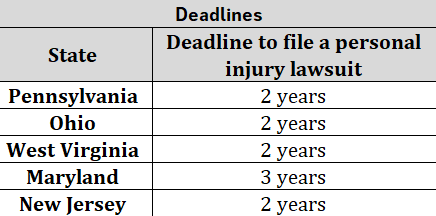
These are general deadlines. Cases involving a death, an injured child, or a claim against a city, county, or state agency can run on different and often much shorter clocks. Some require written notice within months. The only safe assumption is that you have less time than you think.
When the problem is the bike itself
Not every e-bike injury involves a crash. Lithium-ion batteries can fail, and when they do the result is often a fire.
A damaged, defective, or improperly charged lithium-ion cell can go into thermal runaway, a fast self-feeding reaction that produces intense heat, toxic gas, and fire that is difficult to put out. These fires have caused burn injuries, smoke inhalation, apartment and garage fires, and wrongful death.
The federal government has issued warnings. In November 2025, the Consumer Product Safety Commission told consumers to immediately stop using certain Rad Power Bikes lithium-ion batteries, citing 31 reports of fire and 12 reports of property damage totaling roughly $734,500. Some of those incidents happened while the battery was in storage and not being charged or used. The company did not agree to a recall. [19] In March 2026, the CPSC issued a similar warning about Ridstar Q20 and Q20 Pro e-bikes because the batteries and wires can ignite. [20]
Safety certification is voluntary in all five of our states. UL 2849 covers the complete e-bike electrical system. UL 2271 covers the battery pack. UL 2272 covers devices like hoverboards. The CPSC has asked manufacturers, importers, and retailers to comply with these standards. [21] New York City made certification mandatory in 2023. None of Pennsylvania, Ohio, West Virginia, Maryland, or New Jersey currently require it.
If a battery fire injured you or damaged your home, that is a product liability claim, not a traffic case. The manufacturer, the distributor, the retailer, and the seller of an aftermarket battery or charger can all be part of it. That remains true even if the company that made the bike has gone out of business. A bankrupt manufacturer can still be sued, though it requires permission from the bankruptcy court, and if the bankruptcy is filed while a case is already underway, an automatic stay pauses things until the court sorts it out.
Who can be held responsible
Depending on what happened, more than one party may be:
- The driver who hit you
- The e-bike or scooter rider who caused your injury, through their homeowners, renters, or e-bike policy
- The manufacturer, distributor, or retailer, if a battery, brake, weld, fork, or frame failed
- The seller of an aftermarket battery, charger, or conversion kit
- A city, county, or property owner, if a dangerous road or trail condition contributed
- A rental or shared-mobility company, if a device was not properly maintained
- An employer, if the rider was working at the time
If you rented a scooter or e-bike, the rental agreement likely included a liability waiver. Those agreements are long and most people accept them without reading. Do not assume the waiver ends your claim. If you’re not sure where your situation fits, we handle all of our case types under the same free review.
What to do after an e-bike or scooter crash
- Get medical attention, even if you feel like you can walk it off. Head injuries do not always announce themselves.
- Call the police and make sure a report is written.
- Keep the device. Do not throw it out, do not send it back to the manufacturer, and do not let anyone else take it. It is evidence.
- Keep the battery and the charger too, especially in a fire case.
- Photograph the bike, the label on the frame if it has one, the damage, the scene, and the road condition.
- Find your purchase records and the manufacturer’s specifications for the motor and top speed.
- Get names and numbers for anyone who saw it.
- Do not give a recorded statement to any insurance company, including your own, before you talk to an attorney.
- Stay off social media about the crash.
- Call us.
For more on staying safe before anything happens, see our bicycle safety resources.
What to expect from your first call
You talk to a real person. We ask what happened, what you were riding or where you were walking, what you’re dealing with medically, and what the insurance companies have said to you so far. It costs nothing and you are not committing to anything by calling.
If we can help, we tell you. If we can’t, we tell you that too, and we point you somewhere useful.
Why Edgar Snyder & Associates
We have represented more than 75,000 injured people since 1982 and recovered billions of dollars for our clients and their families. We have attorneys licensed in Pennsylvania, West Virginia, Ohio, Maryland, and New Jersey, with offices in Pittsburgh, Erie, Johnstown, Greensburg, Harrisburg, and Altoona.
E-bike and scooter cases are new enough that the law is still catching up, and insurance coverage can get complicated quickly. When an insurance company denies a claim or disputes coverage, we push back.
Call for a free case review. There is never a fee unless we get money for you.
Frequently Asked Questions
Are e-bikes street legal in Pennsylvania?
Yes, if the bike meets Pennsylvania’s definition of a pedalcycle with electric assist: no more than 100 pounds, a motor no more than 750 watts, operable pedals, and a maximum of 20 mph on motor power alone. If it exceeds any of those, it is not an e-bike under Pennsylvania law.
Do you need a license to ride an electric bike?
It depends on the state. Pennsylvania, Ohio, West Virginia, and Maryland do not require a license for a compliant e-bike. New Jersey now does. As of July 19, 2026, every e-bike in New Jersey must be registered and the rider must be licensed, which includes passing an exam.
Do you need insurance for an e-bike?
Not in Pennsylvania, Ohio, West Virginia, or Maryland. In New Jersey, motorized e-bikes now require liability insurance. Some riders carry voluntary e-bike coverage even where it isn’t required.
Are Class 3 e-bikes legal in Pennsylvania?
No. Pennsylvania does not use the Class 1, 2, and 3 system. A bike whose motor can push it past 20 mph on its own does not meet the state’s definition, regardless of what the manufacturer calls it.
Are electric scooters legal in Pennsylvania?
Stand-up electric scooters are not permitted on Pennsylvania roads or sidewalks. The Vehicle Code has no category for them, so they fall under rules that most consumer scooters cannot satisfy. Legislation to change this has been introduced but has not passed.
How old do you have to be to ride an e-bike?
In Pennsylvania, 16. New Jersey sets the minimum at 15. Other states set limits by class, most commonly 16 for Class 3.
Do I have to wear a helmet on an e-bike?
It varies. Pennsylvania requires helmets only under age 12, and since you must be 16 to ride an e-bike, there is effectively no helmet mandate for legal riders. West Virginia requires them under 15. Maryland requires them under 16 on public property. Ohio requires them on Class 3. New Jersey requires them under 17, and at all times for anyone operating a motorized e-bike.
Is an e-bike a motor vehicle?
In Pennsylvania, a qualifying e-bike is legally a pedalcycle, not a motor vehicle. That’s why no registration or insurance is required. But an insurance policy can define “motor vehicle” differently than the Vehicle Code does, and that difference can decide whether a homeowners policy covers an e-bike accident.
Can you ride an e-bike on the sidewalk?
In Pennsylvania, generally yes, except in business districts and where there’s a usable bike lane next to you. You also have to yield to pedestrians and signal before passing. Elsewhere it depends on the state and on local ordinances, which are changing quickly.
Does my car insurance cover me if I’m hit while riding an e-bike?
It may. In Pennsylvania, a qualifying e-bike is a bicycle, so a rider struck by a car is generally treated like a cyclist or pedestrian. That can mean your own policy’s medical benefits apply, and your uninsured or underinsured motorist coverage may apply if the driver had no insurance or not enough. New Jersey now treats low-speed e-bike and scooter riders as pedestrians for personal injury protection purposes.
Who pays if an e-bike rider hits me?
E-bike riders generally are not required to carry liability insurance in Pennsylvania, so there may be no auto policy involved. The rider’s homeowners or renters insurance is often the best available option, though whether it applies depends on the exact language of that policy and whether it treats an e-bike as a motor vehicle.
Can I sue if my e-bike battery caught fire?
Possibly. A battery fire is a product liability claim rather than a traffic case. Keep the bike, the battery, and the charger, because they are the evidence.
What if the company that made my e-bike went out of business?
It complicates the claim but does not necessarily end it. A bankrupt company can still be sued with the bankruptcy court’s permission, and there may be other parties in the chain, including distributors, retailers, and battery or charger sellers.
How long do I have to file an e-bike accident claim?
Two years in Pennsylvania, Ohio, West Virginia, and New Jersey. Three years in Maryland. Cases involving a death, a child, or a government entity can run on shorter deadlines, sometimes just months.
How much does it cost to talk to a lawyer?
Nothing. The case review is free and we work on contingency. There is never a fee unless we get money for you.
Disclaimer
This page is general information about state e-bike and e-scooter laws, not legal advice. Laws change, and how they apply depends on the facts of your situation. Reading this page does not create an attorney-client relationship. If you were hurt, call us and we’ll talk through your specific situation for free.
Sources
- PennDOT, Driver and Vehicle Services bulletin on Act 154, pedalcycles with electric assist: https://www.pa.gov/content/dam/copapwp-pagov/en/dmv/documents/business-partners/driver-and-vehicle-services-bulletin/bulletin%2014-21%20special%20edition.pdf
- Pennsylvania Capital-Star, Move PGH pilot and current scooter law: https://penncapital-star.com/transportation-infrastructure/e-scooters-are-everywhere-in-pa-this-legislation-would-make-them-legal/
- CBS News Pittsburgh, proposed Pennsylvania e-bike legislation: https://www.cbsnews.com/pittsburgh/news/e-bike-proposed-legislation-pennsylvania
- Pennsylvania General Assembly, co-sponsorship memo for HB 2703 (Rep. Cooper): https://www.palegis.us/house/co-sponsorship/memo?memoID=47661&document=HB2703
- Pennsylvania Capital-Star, municipal e-bike ordinances around Pittsburgh: https://penncapital-star.com/transportation-infrastructure/e-bike-surge-powers-suburban-lawmaking-in-pennsylvania/
- Ohio Administrative Code, rule 1501:46-13-05, state park e-bike rules: https://codes.ohio.gov/ohio-administrative-code/rule-1501:46-13-05
- Ohio Department of Natural Resources, state park rules for e-bikes: https://ohiodnr.gov/rules-and-regulations/rules-and-regulations-by-division/state-parks-and-watercraft/ohio-state-park-rules/ebikes
- Baltimore City Code, prohibition on e-bikes and e-scooters on sidewalks: https://codes.baltimorecity.gov/us/md/cities/baltimore/code/31/38-18#(2)
- C&O Canal Trust, e-bikes on the towpath: https://www.canaltrust.org/2019/10/e-bikes-on-the-towpath/
- Maryland Department of Transportation, micromobility quick facts: https://mdot.maryland.gov/tso/pages/Index.aspx?PageId=219
- New Jersey Legislature, P.L.2025, c.285: https://pub.njleg.state.nj.us/Bills/2024/AL25/285_.PDF
- New Jersey Motor Vehicle Commission, e-bike requirements: https://www.nj.gov/mvc/vehicletopics/ebike.htm
- New Jersey Bike & Walk Coalition, FAQ on the 2026 e-bike law: https://njbwc.org/faq-nj-ebike-law/
- Madison Constr. Co. v. Harleysville Mut. Ins. Co., 735 A.2d 100 (Pa. 1999)
- Wilcha v. Nationwide Mut. Fire Ins. Co., 887 A.2d 1254 (Pa. Super. 2005)
- Wolfe v. Ross, 115 A.3d 880 (Pa. Super. 2015)
- State Farm Fire and Cas. Co. v. MacDonald, 850 A.2d 707 (Pa. Super. 2004)
- Coleman v. Soccer Ass’n of Columbia, 69 A.3d 1149 (Md. 2013)
- CPSC warning, Rad Power Bikes lithium-ion batteries: https://cpsc.gov/Warnings/2026/CPSC-Warns-Consumers-to-Immediately-Stop-Using-Batteries-for-E-Bikes-from-Rad-Power-Bikes-Due-to-Fire-Hazard-Risk-of-Serious-Injury-or-Death
- CPSC warning, Ridstar Q20 and Q20 Pro e-bikes: https://www.cpsc.gov/Warnings/2026/CPSC-Warns-Consumers-to-Immediately-Stop-Using-Ridstar-E-Bikes-Due-to-Fire-Hazard-Risk-of-Serious-Injury-or-Death
- CPSC, letter to manufacturers on UL safety standards for battery-powered products: https://cpsc.gov/Newsroom/News-Releases/2023/CPSC-Calls-on-Manufacturers-to-Comply-with-Safety-Standards-for-Battery-Powered-Products-to-Reduce-the-Risk-of-Injury-and-Death
- L.S. ex rel. A.S. v. Eschbach, 874 A.2d 1150 (Pa. 2005).

'%3e%3cg id='Final-Copy-2_2_' transform='translate(1275.000000, 200.000000)'%3e%3cpath class='st0' d='M7.4,12.8h6.8l3.1-11.6H7.4C4.2,1.2,1.6,3.8,1.6,7S4.2,12.8,7.4,12.8z'/%3e%3c/g%3e%3c/g%3e%3c/g%3e%3cg id='final---dec.11-2020'%3e%3cg id='_x30_208-our-toggle' transform='translate(-1275.000000, -200.000000)'%3e%3cg id='Final-Copy-2' transform='translate(1275.000000, 200.000000)'%3e%3cpath class='st1' d='M22.6,0H7.4c-3.9,0-7,3.1-7,7s3.1,7,7,7h15.2c3.9,0,7-3.1,7-7S26.4,0,22.6,0z M1.6,7c0-3.2,2.6-5.8,5.8-5.8 h9.9l-3.1,11.6H7.4C4.2,12.8,1.6,10.2,1.6,7z'/%3e%3cpath id='x' class='st2' d='M24.6,4c0.2,0.2,0.2,0.6,0,0.8l0,0L22.5,7l2.2,2.2c0.2,0.2,0.2,0.6,0,0.8c-0.2,0.2-0.6,0.2-0.8,0 l0,0l-2.2-2.2L19.5,10c-0.2,0.2-0.6,0.2-0.8,0c-0.2-0.2-0.2-0.6,0-0.8l0,0L20.8,7l-2.2-2.2c-0.2-0.2-0.2-0.6,0-0.8 c0.2-0.2,0.6-0.2,0.8,0l0,0l2.2,2.2L23.8,4C24,3.8,24.4,3.8,24.6,4z'/%3e%3cpath id='y' class='st3' d='M12.7,4.1c0.2,0.2,0.3,0.6,0.1,0.8l0,0L8.6,9.8C8.5,9.9,8.4,10,8.3,10c-0.2,0.1-0.5,0.1-0.7-0.1l0,0 L5.4,7.7c-0.2-0.2-0.2-0.6,0-0.8c0.2-0.2,0.6-0.2,0.8,0l0,0L8,8.6l3.8-4.5C12,3.9,12.4,3.9,12.7,4.1z'/%3e%3c/g%3e%3c/g%3e%3c/g%3e%3c/g%3e%3c/svg%3e) Your Privacy Choices
Your Privacy Choices.webp)